Can We Design a Material Backwards?
Developing a new polymer often starts with a list of properties. It may need to adhere to a particular surface, remain stable during processing, provide a barrier for a defined period, or break down under specific environmental conditions. Translating that list into a material is where things become considerably less straightforward.
Polymer performance is the result of an interplay between chemical composition, molecular weight and distribution, molecular architecture, crystallinity, addit
ives and processing conditions. A relatively small change in one of these parameters can affect several properties at once, and not always in the direction that would have been predicted from the chemistry alone. Material development consequently remains an experimental discipline. Models and existing chemical knowledge can narrow the possibilities, but a polymer still needs to be produced, characterised, processed and tested before its suitability for an application becomes clear.
Biological production introduces another set of variables into an already complicated system. In polymers such as polyhydroxyalkanoates (PHA), the microorganism, its metabolism, the substrate it consumes and the conditions under which it is cultivated can all influence the polymer that is ultimately recovered. Two fermentation processes may both produce PHA successfully while delivering polymers with meaningfully different compositions and properties.
For industrial production, this variability is usually regarded as something to control. It also presents an interesting engineering possibility. If changes in the biological production system consistently result in measurable changes in the polymer, those same biological variables could potentially be used deliberately as part of the material development process.
Connecting biology to the material
Industrial biotechnology has traditionally put considerable emphasis on production performance. Strains are developed to improve titre, rate and yield, and fermentation processes are optimised to manufacture the target molecule as efficiently and consistently as possible. These are essential parameters for any commercially viable process, but for a polymer they describe only part of what determines whether a product is useful.
A microorganism may produce a polymer at an attractive titre while the resulting material is too brittle for its intended application, has an unsuitable molecular-weight distribution, behaves poorly during processing or degrades over the wrong timescale. These characteristics only become apparent once the polymer moves through characterisation and material testing, often involving teams and datasets that sit considerably downstream from strain development.
Danu Strain Engineering is developing its methodology around connecting these stages more closely. Biological and fermentation data are combined with polymer characterisation and measured material-performance data, with the intention of understanding how changes made during production propagate through to the final material. ArtemisAI, the company’s computational platform, provides part of the framework for analysing these relationships alongside mechanistic knowledge of the biological system.
This changes the value of the information generated during material testing. A measurement of flexibility, adhesion, thermal behaviour or degradation is not only an assessment of the final polymer; it can also become information about the production system responsible for it. If differences in material behaviour can be related to polymer composition and structure, and those characteristics can subsequently be related to metabolic or process variables, the dataset begins to connect decisions made at the level of the organism with observations made at the level of the application.
The relationship is unlikely to be simple. Polymer properties are influenced by multiple interacting variables, while cellular metabolism introduces its own regulatory and environmental complexity. Establishing useful relationships across these layers therefore requires repeated experimental cycles and sufficiently consistent characterisation. The objective is not to remove this experimental work, but to retain more of the information it generates and use that information when deciding what to produce next.
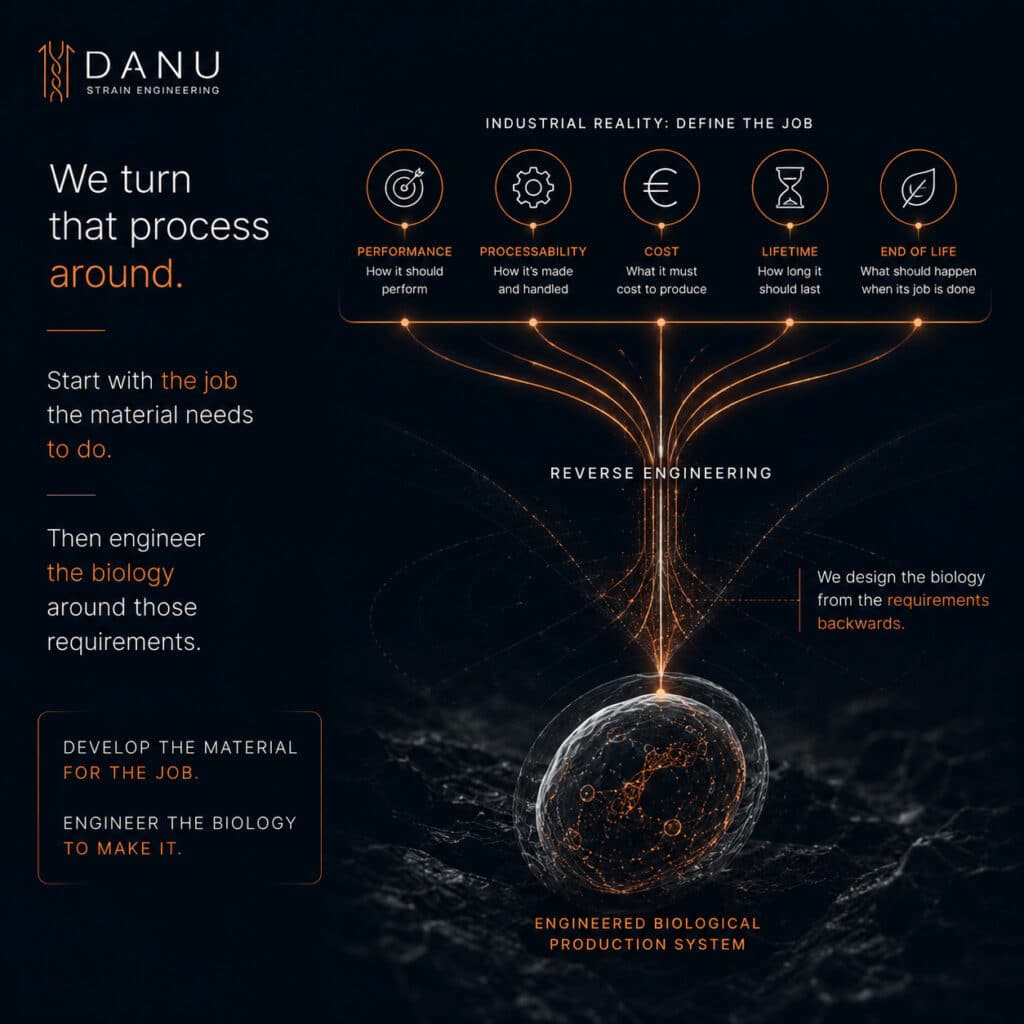
Working backwards from an application
PHA provides a useful system in which to explore this approach because it is not a single material. It is a family of polyesters whose properties can vary considerably depending on monomer composition, molecular characteristics and processing. Biological production adds further flexibility because the polymer produced by a microorganism can be affected by its genetics, metabolism, carbon source and cultivation conditions.
Danu’s current work on PHA for seed coatings starts at the application end of this problem. Together with global companies in the seed-coating industry, the company is defining the properties that a viable coating material needs to achieve before using those requirements to guide polymer development.
Seed coatings are a particularly useful example because biodegradability alone is insufficient. A coating has to tolerate industrial application, storage and sowing, interact appropriately with the seed and other formulation components, and retain its function for the required period. Its degradation behaviour then becomes important after that function has been fulfilled. Improving one of these characteristics at the expense of another does not necessarily produce a better material.
The development problem therefore begins with a combination of properties rather than a single performance target. Different PHA samples can be produced and characterised against those requirements, creating a dataset that relates measured performance to polymer chemistry and structure. The production history of each sample provides another layer of information: the strain that produced it, the substrate used, the fermentation conditions and the relevant biological characteristics of that system.
Over successive development cycles, these observations can be compared. A polymer that performs differently from another is not simply classified as a better or worse candidate. The difference can be examined against its chemical characteristics and production history. Where consistent relationships emerge, they can inform the selection of subsequent strains and process conditions.
Computational modelling becomes useful at this point because the number of possible biological interventions quickly exceeds what can reasonably be explored in the laboratory. Rather than screening that space indiscriminately, biological knowledge and accumulated experimental data can be used to prioritise interventions that are more likely to alter the relevant aspects of polymer production. New experimental results then provide additional evidence with which those predictions can be assessed and refined.
There is an important limitation to this approach. Material specifications cannot currently be translated directly into a genetic design, and describing the process as such would underestimate both the complexity of polymer science and the behaviour of living systems. The more realistic near-term objective is better decision-making: reducing the number of uninformative experiments, recognising relationships across datasets that are difficult to assess independently, and progressively improving the selection of the next biological or process intervention.
Expanding the material design space
The implications extend beyond PHA. Much of the discussion around biomanufacturing has focused on using living systems as an alternative production route for chemicals and materials that are already familiar to industry. In that model, the principal challenge is to manufacture an equivalent product through fermentation at a competitive cost and scale.
Biologically produced materials allow for a somewhat different proposition because the production system can influence the characteristics of the product itself. The organism is therefore not necessarily just a substitute factory for a conventional chemical process. Its metabolism and cultivation conditions introduce another set of parameters that can potentially be exploited during material development.
Using those parameters deliberately requires closer integration between disciplines that have often operated at different stages of the development chain. Microbiology and metabolic engineering need information from fermentation, analytical chemistry and material testing, while material scientists need sufficiently detailed information about how a polymer was produced to determine which upstream variables may explain differences in performance. The practical challenge is as much about connecting these datasets as it is about developing individual models.
Danu is building its development process around that connection. The long-term aim is to establish enough evidence across biology, process, chemistry and material performance that development can increasingly proceed in both directions: forward from an engineered organism to understand the material it produces, and backwards from a required material property to identify the biological and process variables most likely to influence it.
This does not remove the uncertainty inherent in either polymer development or biological engineering. It does, however, offer a way to use the results of each experiment across a larger part of the development process. As those relationships become better characterised, the distinction between engineering the production organism and engineering the material may become less pronounced.
For biologically produced materials, they may increasingly be parts of the same problem.